
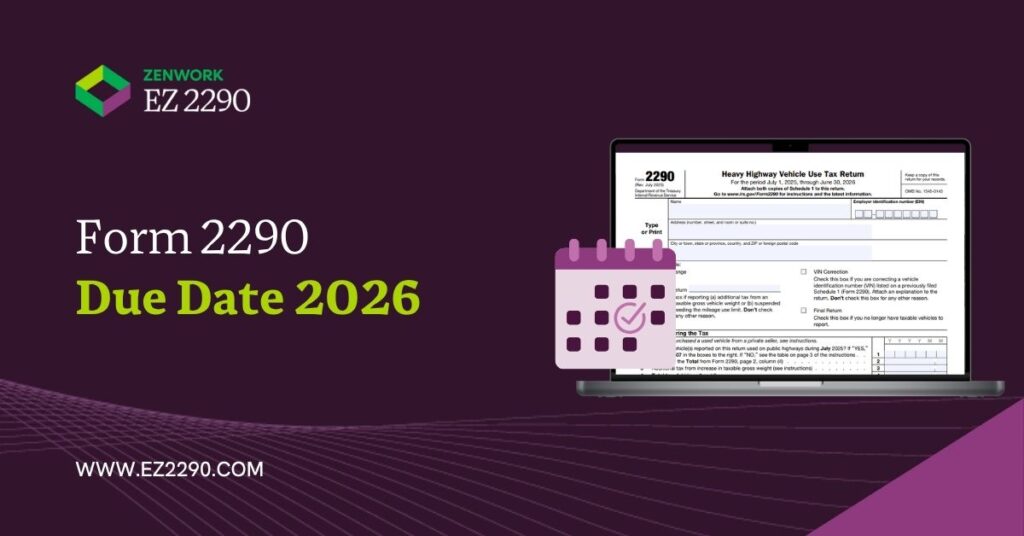
The Form 2290 is an annual filing requirement by the IRS for registered owners of all heavy vehicles (gross weight of 55,000 pounds or more). Once the owner of a vehicle files Form 2290, they receive a watermarked Schedule 1 from the IRS, if all information is accurately filled. A stamped Schedule 1 acts as an official proof that the heavy vehicle use tax was paid or properly suspended for the listed vehicle. For a hassle-free acquisition of watermarked Schedule 1, it’s imperative to file the Form 2290 before the due date. On-time filing supports compliance and keeps registration-related paperwork moving smoothly. Having clarity of the correct due date ensures a clear plan of action for taxable, suspended, and newly added vehicles.
Understanding the Form 2290 Due Date for 2026
The Form 2290 due date matters because it determines when the IRS expects the Heavy Vehicle Use Tax (HVUT) return to be filed. For most taxpayers, the well-known and highly publicized deadline is August 31, 2026, but that date does not apply to every truck in different situations.
What matters most is the month a vehicle is first used on public highways during the tax period. It’s important to note that the purchase or registration of the vehicle is not to be considered. The first use date is considered – this single detail decides when the return is due and whether the filer is dealing with a full-period filing or a later filing during the year.
When is the Form 2290 Due Date?
The final due date for filing Form 2290 is August 31, 2026. The Form 2290 filing season typically lasts from July 1 to August 31. This is sometimes extended, if August 31st falls on a weekend. You can eFile your Form 2290 at any time during this period.
However, these rules do not apply to new trucks. If you have a new truck that hasn’t been on public highways before, there are different rules altogether. You must file your Form 2290 by the last date of the next month following the month of first use.
For example, if the vehicle was first used on public highways in April, then you must file Form 2290 by 31st May. And this is filed on a pro-rata basis. You will have to file again during the tax season, i.e., in July for the coming year. This means the 2026 deadline is not one single date for all trucks.
EZ2290 makes it easier to file on time once the first-use month is known, helping filers move quickly from preparation to submission.
Who needs to file by this date?
The filing requirement generally applies to truck owners, owner-operators, fleets, leasing businesses, and registrants responsible for taxable highway vehicles that meet the weight threshold. There are a few exceptions to filing that need to be considered.
Weight rule:
You must file Form 2290 if your truck crosses the weight threshold of 55,000 pounds gross weight. For most vehicles other than buses, taxable gross weight is the total of: the vehicle’s unloaded weight, the unloaded weight of trailers/semitrailers customarily used with it, and the maximum load customarily carried on the vehicle and those trailers.
Taxable gross weight = truck setup weight + the heaviest normal load that setup is built to carry
You should look at it as “What is the total operating weight of this vehicle when I set it up in its most used combination?”
For example:
Suppose:
- Truck empty weight: 20,000 lbs
- Trailer empty weight: 10,000 lbs
- Maximum load customarily carried: 30,000 lbs
Then:
Taxable gross weight = 20,000 + 10,000 + 30,000 = 60,000 lbs
Since 60,000 lbs is greater than 55,000 lbs, this truck’s owner must file Form 2290.
State registration weight also needs to be considered. If a state requires a declared gross weight, your taxable gross weight generally cannot be less than the highest weight declared in any state.
For example:
Suppose:
- Truck empty weight: 18,000 lbs
- Trailer empty weight: 9,000 lbs
- Customary max load: 25,000 lbs
Your calculation is: 18,000 + 9,000 + 25,000 = 52,000 lbs
Now, this is below the defined threshold of 55,000. So, it would seem that you need not file Form 2290 for this truck. But now assume you registered the vehicle in a state at a declared gross weight of 60,000 lbs. In that case, the IRS would treat it as 60,000 lbs, and Form 2290 would apply.
Mileage rule / suspension:
The IRS offers a suspension of tax in case your truck is used for less than 5,000 miles, even if it weighs beyond 55,000 pounds. This mileage parameter is 7,500 miles in the case of agricultural vehicles.
If a vehicle you reported as suspended later goes over the set mileage limit, the tax becomes due and must be reported on a separate Form 2290 for the prior tax period. The mileage limit applies to the vehicle’s total
highway mileage. Even when a truck is expected to stay under the mileage limit and qualify for suspension, timely filing still matters.
EZ2290 helps both single-truck filers and larger fleets stay organized with status tracking, prior filing records, and bulk import support.
Special Form 2290 Deadline Scenarios for Truck Owners
Not every HVUT owner needs to file Form 2290 in the standard July filing cycle. Truck owners often deal with a variety of cases, be it newly acquired vehicles, changing operations, state registration timing, and multiple units entering service in different months.
Understanding these scenarios helps taxpayers avoid one of the biggest filing mistakes, i.e., assuming every truck follows the same deadline. It also helps them plan for prorated tax.
First-time vehicle use after July
If a truck is first used after July, the return is usually due by the last day of the following month. This rule applies to newly purchased trucks, leased vehicles, or units that begin taxable highway use later in the tax period.
Pro-rated tax for vehicles acquired mid-year
When a vehicle is first used after July, the tax is generally prorated for the remaining months in the tax period. This means both the filing deadline and the tax amount depend on the first-use month.
Extension options and when they apply
Form 2290 does not have a broad automatic extension. Before the due date, a taxpayer may request an extension of time to file by writing to the IRS and explaining the cause of the delay, but an extension to file does not extend the time to pay.
State-specific registration deadlines
Federal filing rules determine when Form 2290 is due, but state registration timing can create added urgency. Filers of all sizes need an IRS-stamped Schedule 1, to ensure a smoother registration process.
Fleet filing considerations
Fleet filing adds complexity because different trucks may have different first-use months, VIN entries must be accurate, and rejected returns must be corrected and resubmitted quickly. EZ2290 helps fleets with bulk import, secure filing, and free re-file support for rejected returns.
Penalties for Late Form 2290 Filing
Late Form 2290 filing can create both financial and operational problems. Penalties may apply when the return is not filed or paid on time. Late filing can delay access to Schedule 1, and eFiling generally provides faster delivery of a watermarked Schedule 1 after IRS acceptance.
For truck owners, that can mean extra expense, more paperwork, and avoidable stress during a busy season. Filing early is often the easiest way to reduce that risk. EZ2290 helps by offering a guided e-filing process,
secure submission, and filing status tracking so filers can identify and resolve issues sooner.
Steps to File Before the 2026 Deadline
Following a step-by-step process helps truck owners file Form 2290 on time, avoid errors, and get their stamped Schedule 1 without last-minute stress.
Step 1: Confirm whether the vehicle must be reported
Check whether the vehicle meets the filing requirement based on taxable gross weight and registration status. Also, confirm whether it will be reported as taxable or suspended.
Step 2: Identify the vehicle’s first-use month
Find the month the vehicle was first used on public highways during the tax period. This month generally decides the correct Form 2290 due date. This is imperative for any vehicle being reported for its first used month in the current tax period, including vehicles first used in July and vehicles first used later in the year.
Step 3: Gather all filing details before starting
Keep your EIN, business details, VIN, taxable gross weight, first-use month, and payment information ready. This makes filing faster and more accurate.
Step 4: Review whether the tax will be full-year or prorated
If the vehicle was first used after July, the tax is generally prorated for the remaining months in the tax period. This helps prevent reporting the wrong amount.
Step 5: Enter the vehicle information carefully
Fill in the VIN, weight category, first-use month, and taxable or suspended status correctly. Small mistakes can lead to rejection or delays.
Step 6: Submit the return before the due date
File Form 2290 on time based on the vehicle’s first-use month. Filing early gives you extra time to fix issues if the return is rejected.
Step 7: Track the filing status after submission
After filing, check whether the return has been accepted or rejected. Quick follow-up helps prevent a correctable error from becoming a larger problem.
Step 8: Access and keep the stamped Schedule 1
Once the return is accepted, save your stamped Schedule 1 for registration and recordkeeping. Keeping it handy supports future compliance needs.
Step 9: Handle post-filing corrections or follow-up actions if needed
If a VIN needs correction or another vehicle is added later, take action promptly. EZ2290 helps eligible filers manage these follow-up needs more easily.
Conclusion
The most important thing to remember about the Form 2290 due date for 2026 is that it is not the same for every truck, because the correct deadline depends on when the vehicle is first used on public highways during the tax period. Once truck owners, fleets, and tax professionals understand that rule, they can avoid common filing mistakes, stay ahead of penalties, and keep registration-related paperwork moving without unnecessary delays. EZ2290 helps make that process easier with secure e-filing, Schedule 1 delivery after IRS acceptance, filing-status tracking, and support for features such as VIN corrections and rejected-return re-filing.
FAQs
1. When is Form 2290 due in 2026?
The Form 2290 eFiling due date is 31st August 2026. For new vehicles that are first used after the July cycle must follow the last day of the following month rule.
2. Is Form 2290 always due in August?
No. August is the main deadline only for vehicles that have been in service for a long period, or for trucks first used in July. Trucks first used after July generally have later monthly deadlines.
3. Do suspended vehicles still need to be filed?
Yes, filing Form 2290 is imperative for all vehicles above the gross weight of 55,000 pounds. You must file Form 2290 even when the tax is suspended because of expected low mileage.
4. What happens if I buy a truck later in the year?
If you buy a new truck, you must file Form 2290 based on that truck’s first-use month, and the tax is prorated for the remaining months in the period. It is important to remember that Form 2290 does not run on a
calendar year. It runs on a tax period from July 1 through June 30.
5. What if my Form 2290 return is rejected?
If your Form 2290 is rejected, then you should scrutinize your filing, review the rejection reason, correct the issue, and re-file promptly. EZ2290 offers free re-file support for rejected returns.